Wednesday, 12 October 2022

Paul 1


The Acts of the Apostles is really the only account we have of the history of the early Church. This book of some, some twenty-eight chapters notwithstanding Jesus’ last words and his ascension, begins the story of the Church under the leadership of the Apostle Peter before giving way to the missions, the life and the leadership of Paul. You will recall that Paul had started out as Saul the Pharisee and in the Acts of the Apostles he begins as Saul the persecutor of the church in Jerusalem and we can be reasonably certain that he, Saul was partly if not largely responsible for the murder of Stephen, the first Christian martyr whom the Jews stoned to death.


As a result of these persecutions, the members of the early Church in Jerusalem fled to different areas including Damascus in Syria. And you will recall that it was Saul who obtained authority, letters of authority from the Jewish leaders to travel to Damascus in Syria to arrest the Followers of the Lord’s Way (this was what the people of the Church were known as before they were known as Christians) You will know too, that on the way to Damascus, that Saul was blinded by an intense light and that as this happened he had an encounter with Jesus, we could say that he had an encounter with the living Christ that led to his conversion and his eventual leadership of the Christian Church.


I think it is important for us to understand how after the life of Jesus of Nazareth on this earth, and the fading of Peter in the New Testament narrative, how Paul in the life and the history of the early Church became the dominant figure, the leading figure. For example, the New Testament contains twenty-seven books, and fourteen of these books, letters, epistles are all attributed to Paul. If we were to also consider the Acts of the Apostles, written by Luke, we could say that Paul, notwithstanding the four gospels, ‘strides through the pages of the New Testament as a colossus.’ Without Paul there would be no Christian Church today; that is almost certain.


If you want to see how this man saw himself in his new role as an apostle to the gentiles, we can simply turn to his First Letter to the Corinthians (15: 9-11) in which he wrote:


I am the least important of all the apostles. In fact, I caused so much trouble for God's church that I don't even deserve to be called an apostle. But God treated me with undeserved grace! He made me what I am, and his grace wasn't wasted. I worked much harder than any of the other apostles, although it was really God's grace at work and not me. But it doesn't matter if I preached or if they preached. All of you believed the message just the same.


If we look at that statement you can see the deep humility of Paul. He recognised that in the past that he had caused a lot of suffering to those who were followers of Christ. He caused a lot of suffering before he himself was converted. And what crimes against those followers of Christ he committed! The door-to-door harassments, the imprisonments, the beatings and even worse. In view of all this, you could very easily argue that this horrible man had no right whatsoever to declare himself an apostle. But God had other plans. Paul was saved and transformed by the grace of God to fulfil a mission that would change the world.


I want to bring Paul alive for you, I want to bring Paul into focus for you because we often hear of this man who was so central to the forming and the foundation of the Church. We don’t have any contemporary portraits or picture of him but there is a written description of him that has survived from the second century that reads:


He was a man, ‘small in size, bald-headed, bow-legged, well built, with eyebrows that met, rather long-nosed and full of grace.


From the description I think we could say that he had hardly got film star good looks. Apart from his other features, I think that from all that he endured, being small and well-built would be an asset; Paul was a powerhouse of a man. What else? Full of grace, full of grace. Perhaps being full of grace is hardly anything that could be put on a passport description. Nevertheless, Paul had an undeniable presence, a discernible presence and that presence certainly could be summed up in that description of being ‘full of grace.’ That undeniable presence, that undeniable presence, down through the centuries has left its indelible mark. I think we are privileged today that we too are the inheritors of Paul’s legacy and the clues about his looks, his stature, and his indomitable personality. All this information we have concerning Paul is a gift, the story of his life bequeathed to us, to the Church and to all believers.


What I’d like to do for you, if you will let me, is to impress on you this inspiring image of Paul. Of Paul as a real flesh and blood person who really did live out the message and the final commands of Jesus, Jesus who said:


All authority in heaven and on earth has been given to me. Therefore, go and make disciples of all nations, baptizing them in the name of the Father and of the Son and of the Holy Spirit, and teaching them to obey everything I have commanded you. And surely I am with you always, to the very end of the age. Matthew 28:18-20


In fact, after his conversion on the road to Damascus he, Paul, gave up everything that he had so that he could serve the Lord. Paul was a man on a mission who had absolute trust and faith in God. We do need to know something of the past, something of the early Church so that we can understand the present, so that we can deal with life in the here and now. This thing we call Christianity is not all ‘gentle Jesus, meek and mild’, it’s not just a comfort blanket for a sleepy Sunday morning as though it doesn’t really matter, as though Christianity is not about the real world. So, I think we should remember those words of Jesus when he said:


Think not that I am come to send peace on earth: I came not to send peace, but a sword. For I am come to set a man at variance against his father, and the daughter against her mother, and the daughter in law against her mother-in-law. And a man's foes shall be they of his own household. (Matthew 10:34-36)


What we can say with any certainty is that the Church grew out of opposition out of persecution. That sword that Jesus spoke about is a great divider. It is not that we want to be divided against each other our against friends, our neighbours our families but often we don’t have a choice, because the minute you decide to stand up for what you think is right, the minute you speak power to truth you will get opposition and inevitably it will be so if you take a stand for Christ. Jesus said, ‘If the world hate you, ye know that it hated me before it hated you. Today the world hates Christianity more than ever before, but the story of Paul’s life and ministry gives us hope and shows us that for Christians strength comes from adversity. Such is the power of God.


Photograph: Peloponnisios, CC BY-SA 4.0 <https://creativecommons.org/licenses/by-sa/4.0>, via Wikimedia Commons


Monday, 5 September 2022

Mark 9: 41-42: A Large Millstone Around Your Neck


Leon Trotsky in his autobiography, My Life, reflecting on his own childhood said, ‘Life strikes the weak – and who is weaker than a child?’. By the same token in 2003, I once heard, on the radio, someone make a comparison between Tony Blair the then British Prime Minister and George Bush, the President of the United States at the time that both countries were on the verge of launching the Second Gulf War. The comparison was that Blair should shoulder most of the responsibility for the forthcoming attack on Iraq, because Blair was brighter than Bush. Figuratively speaking, Tony Blair was presented as the older child who should have known better than to encourage the more naïve, or perhaps less intelligent, younger child George Bush.

I’m reminded of hearing these words on the radio all those years ago, after reading William Barclay’s commentary on leadership that causes other people to sin. Barclay’s remarks refer to the words of Jesus from the Gospel of Mark 9: 41-42:

But if you cause one of these little ones who trusts in me to fall into sin, it would be better for you to be thrown into the sea with a large millstone hung around your neck.

You will remember Barclay’s words as read out this morning:

God is not hard on the sinner, but God will be stern to the person who makes it easier for another to sin, and those whose conduct, either thoughtless or deliberate, puts a stumbling-block in the path of the weaker brother.

There’s a saying that’s cropped up for me a few times just recently and that saying goes, ‘You don’t know what you don’t know’.  A friend of mine once said, ‘I’m never wrong because when I am wrong then I’ll admit I’m wrong and then I’m right again’. Jesus said that the truth will set you free (John 8:31-32) to know the truth, to embrace it in Christ, and to live it is the freedom that Jesus spoke about. He was talking of freedom from sin. Surely if we know the truth and choose to ignore it, then that has got to be worse than knowing the truth but ignoring it.

I’m sure we are all aware of Jesus’s explicit, heartfelt plea from the cross on behalf of those who sinned in ignorance. And so, we have these words from the Gospel of Luke:

Two others, both criminals, were led out to be executed with him. When they came to a place called The Skull, they nailed him to the cross. And the criminals were also crucified—one on his right and one on his left. Jesus said, “Father, forgive them, for they don’t know what they are doing.” And the soldiers gambled for his clothes by throwing dice. (23:32-34)

 Jesus’ words uttered from the cross, ‘Father forgive them for they know not what they are doing’. It takes great compassion and understanding, as Christ had, in the throes of one’s death agony to both forgive and understand one’s tormentors and persecutors. Thus, we have the prayer attributed to St Francis of Assisi, these words:

‘O Divine Master, grant that I may not so much seek to be consoled as to console, to be understood as to understand; to be loved as to love… 

I once met someone who alluded to her spiritual journey, I think she was much inspired by Buddhist teaching and she spoke of what she called the elimination of the ego and whether or not she could do it. But Christian teaching is more effective in that it promotes the virtue of humility. We should have a good opinion of ourselves, you and I all of us. We should have a good opinion of ourselves, but none of us are perfect and the truth of the matter, really is that we are all sinners, in spite of what the liberal Christians may say. None of us are worthy of God’s love, but He gives it to us anyway, this as an act of grace. Was it not an act of grace that Christ could cry out from the cross, ‘Father forgive them for they know not what they are doing?’ After all these years, I really think it’s not possible to eliminate the ego. we should remember that we are fallible indeed. Rather, I think we should accept the view of the prophet Isaiah, that we are all fundamentally flawed and that the human heart is deceitful and that outside the grace of God’s love and forgiveness, His salvation, we are beyond redemption. If we bear this in mind, we might avoid spiritual pride. We might avoid spiritual pride because we ought to realise that our forgiveness, God’s love is dependant not on what we do, but what God will do for us. The prophet Isaiah wrote:

The human heart is the most deceitful of all things, and desperately wicked. Who really knows how bad it is? (17.9)

I find these words of Isaiah can be useful to bear in mind when one is tempted to think too highly of oneself. In the same vein, I think that these words of Paul in his letter to the Church in Philippi are helpful.

Don’t be selfish; don’t try to impress others. Be humble, thinking of others as better than yourselves. Don’t look out only for your own interests, but take an interest in others, too.

Don’t look out only for yourself, said Paul but look out for others too. Our looking out for others is because with knowledge and faith comes responsibility. We Christians know of God because we see him in His creation and we Christians know of God because we can read his word. We Christians therefore have no excuse. This religion of ours is not a passive affair it requires active faith. But those who profess faith whilst knowingly placing stumbling blocks in the way of others leading them to sin and failure will be condemned. I began by talking about the vulnerability of children, you will remember those words, Life strikes the weak – and who is weaker than a child? You will remember that story this morning from William Barclay’s commentary of the little girl who eventually died after ending up on the streets in prostitution because of neglect.

So, while we are thinking of the vulnerability of children, let me read this to you from the Manchester Evening News: 21 August 2022:

Drag Queen Story Hour, which has been running worldwide since 2015, is an initiative where drag queens will usually take over a library or a community centre for an hour and read stories to children. The initiative aims to break down stereotypes and bias from a young age.

Oldham Councillor Louie Hamblett has told the MEN it is 'sad' that further security is needed in 'today's age' and added the show is an 'activity open to all'. Protestors have previously claimed the show is brainwashing children, with protestors also ambushing an event in Bristol last month.

The Liberal Democrat Councillor from Crompton, Oldham, said: "I think it's sad that additional security is required in today's age. It's an activity that's open to all and welcomed by both parents and children who attend for a morning or afternoon of story time.

This isn’t about agenda’s or pushing ideas onto people. This about reading books, telling stories with excitement, colour and fun.

I could ask why on earth drag queens are required to read stories to children? I could ask, but you know what? That would be a disingenuous question. Because you know and I know why this is being done, it’s being done to advance an LGBT agenda, it’s been done in the words of Louie Hamblett the Liberal Democrat councillor from Crompton to break down stereotypes and bias from a young age. What she means is that it’s being done to break down traditional family values, it's being done to disempower parents, it's being done to corrupt children. It is a satanic agenda to undermine the Christian basis of society. As I’ve said, this is being done to corrupt our children and how do they do that? They aim break down to break down stereotypes.

They aim to breakdown the stereotypes that children need to see in their early years of development, the archetypes, the difference between mummy and daddy they need to know the difference between right and wrong, to know the difference between good and evil to know the difference between boys and girls, to know the difference between men and women, so that they gain a sound basis of understanding for life, so that they can identify with their God given sex and gender and can live out their lives on this earth righteously in accordance with God’s plan for creation.

Undermining the family, undermining parents, and corrupting children is a sin.

We know what Jesus would say:

But if you cause one of these little ones who trusts in me to fall into sin, it would be better for you to be thrown into the sea with a large millstone hung around your neck.


 Photograph: By Paasikivi - Own work, CC BY-SA 4.0, https://commons.wikimedia.org/w/index.php?curid=118002857

Thursday, 4 August 2022

A Relationship with God


 The Lord was with Joseph, so he succeeded in everything he did as he served in the home of his Egyptian master. Potiphar noticed this and realized that the Lord was with Joseph, giving him success in everything he did. This pleased Potiphar, so he soon made Joseph his personal attendant. He put him in charge of his entire household and everything he owned. From the day Joseph was put in charge of his master’s household and property, the Lord began to bless Potiphar’s household for Joseph’s sake. All his household affairs ran smoothly, and his crops and livestock flourished. So Potiphar gave Joseph complete administrative responsibility over everything he owned. With Joseph there, he didn’t worry about a thing—except what kind of food to eat! Joseph was a very handsome and well-built young man 

                                                                                                            Genesis 39:2-6 NLT 


In a recent conversation with another minister, we talked about the churches, how they are today and what is actually going on and what is being preached in those churches. It’s an important question because any church congregation on a Sunday should hear something from the preaching of the word, that is at least inspiring and meaningful to them. The preached sermon in ethical terms, should offer encouraging words for day to day living and the message of that sermon has surely got to be of some spiritual value. In other words, a sermon has got to have direct relevance to the lives of its listeners. 

Therefore, what I’m preaching today must have some direct relevance to your life too! It’s not just my job to attempt to present some information to you or to say something interesting, though I suppose that wouldn’t be a bad thing. The question is, how important is that preaching within the context, for example of a Sunday service? Well, the truth is that the preaching is the most important part of the Sunday service. It says so in the Bible. Real preaching is about speaking for God. In his letter to the Romans, St Paul said that faith comes from hearing, that is, hearing the Good News about Christ. Faith comes from hearing and that’s how important preaching is. Preaching should awaken faith; it should inspire faith and it should encourage faith. 

 And faith is essential, it’s what’s actually required of you, it’s essential to your own personal ministry? Yes, that’s right, your own personal ministry. As followers of Jesus, we all have a ministry. So, the next question is, does your faith make a difference outside of this chapel, does your faith make a difference in the outside world amongst other people, even amongst unbelievers? Does your faith make a difference? Because you and I, all of us, we who are gathered here today, need to know- and this is the message for today- we need to know- that we do have to make that difference. Because we are judged are we not? - Not so much by what we say we are, but rather by what else we say and ultimately what we do. If we profess to have a faith and it doesn’t make a difference either to us or to anyone else, then the truth is we really don’t have a faith and it would all be pointless. 


We might not think that the conditions are always favourable to us, in the world, this outside world that I’m talking about, the conditions are not always favourable towards our acting out our highest Christian ideals, our love of God and loving our neighbour as we love ourselves. It’s not always easy. It’s not easy because we have to deal with what they call ‘the nitty gritty of life’, the nitty gritty of life, the adversity of it all and the unexpected problems that always seem to pop up. When things seem always to be going against us, when it's difficult to make headway. And when our intentions are misunderstood, when the world seems to be against us, and when we make our own mistakes as well. So, in line with this knowledge that life doesn’t run smooth, it throws up challenges and problems all the time, in line with all of this and more, I’ll mention an adage that no doubt you will have heard, an adage that has been described as ‘a proverbial phrase used to encourage optimism and a positive can-do attitude in the face of adversity, discouragement, setbacks and misfortune’. It reads like this: 

When life gives you lemons, make lemonade. 

The explanation being that, ‘Lemons suggest sourness or difficulty in life; making lemonade is turning them into something positive or desirable.’ 

But being positive, or staying positive is one of these popular virtues we are always being told about. I mean to say, we would always prefer the company of someone who has a positive attitude rather than a negative one. Who wants to listen to someone who is always whinging? We know from experience that negative people are physically and spiritually sapping. At the same time, I think it’s not always possible to put a positive spin on a negative situation. Sometimes it’s best just to say nothing. Sometimes we just have to accept things the way they are or just the way that things have panned out. Sometimes we just have to remember to live in faith and put our trust in God. 

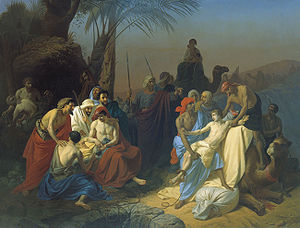
 You’ll remember that story in the book of Genesis, Joseph and his coat of many colours, Joseph, who when he was about 17 years of age was stripped of his special coat, made for him by his father, Jacob, and then he was sold into slavery by his jealous and hostile brothers. Later, he was resold as a slave again, in Egypt. How bad can that be, how bad can that be to be sold into slavery by your own kith and kin, sold into slavery by your own brothers? How rejecting and how painful that experience must have been! That’s not something that can be easily forgotten! But there was a man named Potiphar, who bought Joseph as a slave and he soon recognised that there was something about Joseph, something different and we know that because the Bible tells us that the Lord blessed Potiphar’s house for Joseph’s sake. 

And then when Joseph found himself unjustly imprisoned even the keeper of the prison in Egypt saw that there was something godly about Joseph, the Lord was with him and so the jailer treated him accordingly and treated him well. Eventually Joseph rose to become second only to Pharaoh in command in Egypt. Why should that be? Because the Lord was with him, it’s as simple as that. Joseph had a relationship with God. You know that none of us will probably ever rise to high office as Joseph did, but that’s not the point, is it? I mean even as a slave in prison, in what should have been another low point in his life, Joseph’s relationship with God still made a difference. Joseph didn’t achieve anything by making positive affirmations about changing lemons into lemonade or whatever the Hebrew or Egyptian equivalent would have been. He achieved through the grace of God because God was with him, because he had a relationship with God. 

And therefore, I say to you, that your ministry too, is about your relationship with God, it’s about your prayer life, it’s about your faith, it’s not about trying to look good, or by pretending that bad things don’t happen, but it is about holding on to your faith and by allowing that inner light of yours to shine so that as Jesus said in his Sermon on the Mount ‘let your light shine before others so that they may see you and praise your Father who is in heaven.’ What we must do, you see, is to live only to the glory of God. That’s the Christian goal, to live our lives to the glory of God. ‘Take up your cross and follow me,’ said Jesus. We have to put God first! And our lives before God need to be lived with some humility and some self-examination, we never know at any given time what God has got planned for us. It’s about submission, it’s about trust and faith, putting our hand in his and walking with him and as I’ve said, it is about humility and self-examination, so, I would just like to close with these words from the 139th Psalm: 

Search me, O God, and know my heart; test me and know my anxious thoughts. Point out anything in me that offends you, and lead me along the path of everlasting life.

Monday, 4 July 2022

Job Reflection 6


Today, we return to the story of Job and his sufferings. It's quite some time since we considered these pages of scripture. It’s scripture that was written thousands of years ago in an attempt to deal with what we now know as ‘the problem of suffering', or ‘the problem of evil.’ Why do bad things happen to good people if as we claim our God is a God of justice and mercy? However, we do get a glimpse of the mind of God through the teachings of Jesus who said that we should love our enemies and pray for those that persecute us. He effectively said that through this practice of unconditional love that we too would be acting in a god-like way:


For he gives his sunlight to both the evil and the good, and he sends rain on the just and the unjust alike. (Matt 6:46).


This is the standard of required Christian behaviour.


For you are to be perfect even as your Father in heaven is perfect, (6:48)


And so, we see through these words that Jesus revealed an aspect of God we don’t often think about and that is God's apparent impartiality, or more accurately is his unconditional love.  What does he do?  He sends the rain and the sunlight to both the just and the unjust, to the righteous and the unrighteous.  It makes me think of a kind person who is generally loved because they are always to be kind to others whoever they are. And then we have the other sort of person who has a ‘reputation’ and is known to be rude and insulting.  Sometimes we might say of that person, he doesn't discriminate - he's rude to everyone! Not that I'm talking about God in the same breath, as these two very human examples. I'm just saying that the blessings of God, on this earth are visited upon everyone. We all have the privilege of life and as surely as we are all different in our own ways, we all experience life as individuals and as individuals we will surely be judged.


Admittedly, some people are born into enormous privilege while even today some people are born into slavery.  Yes, terrible things do happen to all kinds of people, even to the rich and powerful.  The sun shines and the rain falls on the just and the unjust, and we wonder where God’s justice actually is.  But Jesus said:


'If you are kind only to your friends, how much different are you from anyone else?'  Even pagans do that but you are to be perfect even as your Father in heaven is perfect. (5:47-48) 


So here Jesus is pointing to a level of holiness, a standard of perfection that we will all find difficult to achieve, but difficult also to understand. We know that at a common-sense level that negative behaviour should not be rewarded.  For example, we can’t expect the judge in the law courts to sentence Burglar Bill to a two week all paid expenses holiday in Majorca!


We know that we live in a world of cause and effect.  Night follows day, the tide comes in and goes out.  We know that the universe is subject to certain unwavering rules.  And when we look at the world and creation, we can either believe that that in itself proves that there must exists a creator God or perversely we may conclude that there is no God.  Either way, we are left with the same problem – if God does exist, why do we suffer? Or, God cannot exist because we do suffer. 


Having made that little detour, let’s get back to Job and his sufferings.  You will remember that not only did Job lose all his worldly wealth, including his servants, but also his seven sons and three daughters who were also killed.  And you’ll remember also that Satan had him covered from head to foot with boils.   Memorably, his wife had said ‘Curse God and die’, and that his three friends Eliphaz, Bildad and Zophar, sat on the ground with him for seven days and nights, so great was his suffering that no one spoke to him. 


In my last sermon on Job, I covered this last point of how Job’s friends who saw how much he was suffering, sat with him in a silent vigil for seven days and seven nights. With this in my mind, my last sermon on Job was in part a celebration of friendship pointing out how important friendship is to each one of us.  But as I also said, that I think it’s important to understand the limitations of friendship, and that’s how I left it.  But it’s worth considering those words of Professor Edward Musgrave Blakelock, who in spite of the negative connotations traditionally ascribed to Job’s friends, that is ‘Job’s comforters’, reminded us that,


“They wept and took their places by Job’s side and sat for seven days in silent sympathy, struggling with their thoughts.  Here surely was fellowship, more real than some friends gave.


I have to say, that is undoubtedly true. However, what I’d like to do now is to draw your attention to a key verse almost right at the beginning of the story of Job. In fact, having thought about it, it is essential to our understanding of the whole story and in that key verse Job’s character profile was laid out for us when God said:


Have you noticed my servant Job?  He is the finest man in all the earth.  He is blameless – a man of complete integrity, he fears God and stays away from evil. (1:8) 


What did God say of Job? Again, what did God say of Job? He said, ‘He is the finest man in all the earth’ – God didn’t say, ‘He is one of the finest men in all the earth.’  He said Job ‘is the finest man in all the earth.’  And he said this to Satan, who in this story (Job 1:6) is Satan the Accuser.  Satan the fault finder.  Remember that Satan is a fallen angel who always opposes God and always seeks to replace good for evil.  We see his work in the world today. How evil gets a grip, how rational and how reasonable evil can appear to be, how innocent it can appear to be. How easy life could be if only you would bow down and worship me, says Satan. And in the face of all his suffering how easy it would have been for Job to have done just that. To give in to despair and to give up on God.


Satan, when confronted with the example of Job, reminds me of certain men. Men, who when shown an example of a successful man, a man worthy of admiration, of emulation even - will simply dismiss him as a fool.  And that conveniently ends the argument, doesn’t it!  Because such men are evil and they cannot bear to be shown that another man is in fact an altogether better man than they are.  And when it’s pointed out to them, how others who live closer to God live better lives than they do, they see it as an affront.  How galling then must it have been for God to say to Satan ‘Have you seen my servant Job – he is the finest man in all the earth’.  And so, bearing this in mind I have to conclude that God had a very definite purpose in saying that to Satan. For reminding that fallen angel, Satan, of the virtues of integrity and holiness.  And so, Satan affronted, acted predictably in a like negative manner, really wishing to destroy Job because for him it was easier to curse than to bless.


Turning to Job’s friends, we now consider Eliphaz (in chapter four) who was the first to speak because it’s thought that he was the most senior and the most learned of the three.  So, in effect, I suppose that what Eliphaz had to say was the best shot that this threesome were going to have at finding a rationale, a cause, a reason that might lie at the root of Job’s suffering.  Like Job, none of his friends were privy to the deliberations of the heavenly court, and the exchange between God and Satan, but once again I remind you of Job’s approval in the eyes of God, who said of Job that he is the finest man in all the earth.  And I really want to emphasise this point, because if God said so, then Job at the time was the saintliest man on earth. Again, on the authority of God’s word, in the context of this story Job was indeed the world’s number one spiritual superstar.  Even so, he was still not perfect and he had certainly been brought low by the curses that Satan has heaped upon him. 


Now Eliphaz, as I have said, the most senior of his friends, had been placed in a privileged position through his friendship with Job, and really, his role was to comfort Job and to counsel him. But, as the story unfolds, Eliphaz proved he was not up to the task.  Right from the start we can see that Eliphaz carried away by his own egotism, totally misreading the situation. Eliphaz was unaware, that Job even in the depths of his misery and new found poverty in every respect was still by far superior to him. But Eliphaz was so buoyed up by a newly found sense of his own importance that he rudely broke into Job’s monologue saying “Will you be patient and let me say a word?  For who could keep from speaking out?” 


The Bible tells us that that Eliphaz the Temanite replied to Job. He certainly did reply to Job! But the overriding tone that his words convey was a tone of irritability and a barely concealed irritability at that.  I would say that if there was any sympathy with Job’s plight that may have been existent in the silent vigil of the past seven days and nights, then that sympathy was not evident in these opening words “Will you be patient and let me say a word?”  And that is certainly confirmed in the next three verses:


Then Eliphaz the Temanite replied to Job:

“Will you be patient and let me say a word? For who could keep from speaking out?

In the past you have encouraged many people; you have strengthened those who were weak. Your words have supported those who were falling; you encouraged those with shaky knees. But now when trouble strikes, you lose heart. (4:3-5)


In these words, there is an assumed superiority, a great man has been brought low and Eliphaz we can be sure on the evidence of such language spoke to Job with such disdain. He didn’t even treat him as an equal. I’m sure Eliphaz seeing Job reduced to such a wretched state whilst he himself remained untouched, must have thought that his day had come, that he was the one now justified before God, believing without a doubt that Job must definitely have committed a sin for all those disasters to have fallen upon him.


The real question at the heart of the story of Job, is ‘why do bad things happen to good people?’ and that question wasn’t even a consideration by Eliphaz because he thought he knew all the answers. In short Eliphaz’s dogmatic pronouncements can be seen for what they were; a mixture of complacency, arrogance and pride.  But what is the most hurtful in the initial utterances of Eliphaz is his blind ruthlessness in feeling that he was justified in accusing Job of practicing double standards. Basically, saying to Job, you were pretty good at handing out advice to others in their distress when things were going all right for you, but when it happens to you can’t handle it:


But now when trouble strikes, you lose heart. (4:5)


In another age, the words of Oliver Cromwell with much justification could have been directed at Eliphaz:


I beseech you, in the bowels of Christ, think it possible that you may be mistaken.


I believe that Max Ehrmann brought us all a lesson in personal humility when he wrote these words:


If you compare yourself with others, you may become vain or bitter, for always there will be greater and lesser persons than yourself.


Such wisdom applicable to Eliphaz, we too should take to heart.

We don’t know it all and neither did Eliphaz.